“Architecture is frozen music” was what one of Vibeke Sorensen's professors had said when she was at college. In response to this she thought about re-liquefying the music to make a fluid structure that will be in motion. In a way, she is in pursuit of morphing spaces to create room for more visual elements as well as audio features. The cutting edge art that we name "multimedia art" gives every option to push artistic vision to its limits. Even defying such limits. However, this is no easy task.
Solid Architecture Behind “Liquid Architecture”: Building Liquid Architecture by the People, for the People
Vibeke Sorensen in her lecture explained how the tools she’s been using to create her animations have changed over time from huge oscillators to more compact and convenient tools of her time. One thing stayed constant: her animations were mere reflections of organized patterns of zeros and ones. However, such “mere reflections” can only be achieved through “defying limits of technicality” as Sorensen puts it. Technology is “still not good enough” to be on its own. Perhaps through artificial intelligence it may be good enough in the future but for predictable future: an artist’s vision is necessary to shape the end product.
One of the reflections of organized information is being displayed at the National Gallery of Art’s concourse level combining East and West buildings together. The light sculpture of Leo Villareal exhibits patterns that almost leave you wondering if you are deaf for a while. The patterns are so rhythmic that they provide a sense of “visual music,” a concept that Sorensen likes to work with. This concept was also used by Stan Brakhage in his works like black ice and dante’s quartet which were all silent movies showing fast-paced visual material. It is just amazing to see how technology has allowed visual music get out of virtual environment to environment of galleries, exhibit halls and other places of display.
Transforming reality into abstraction and vice-versa is probably the most crucial element that makes me feel excited when I view works of these artists. As the context of art-work becomes more fluid, meanings attached to work morph and we associate what we see by not categorizing it with another concept but rather by associating meanings with emotions. Thus we derive new meanings. Liquid architecture in that sense is a challenge to our senses…a sort of breakthrough from the chains of reality into world of possibilities.
The following are some photos from Leo Villareal’s Multiverse in National Gallery of Art. Photos from installation can be found by clicking here.


Standing halfway through the walk path, one almost feels like entering a different universe under blue and yellow lights. No wonder the piece is called Multiverse. Best part is, it gives the viewer the opportunity to be in the piece for a while. Leo Villareal's previous work Field displayed in New York gives a taste of visual music to viewers.
Visual Music - Liquid Architecture Relation: Does Seeing Mean Hearing?
Working with visual patterns that reflect rhythmic qualities was something Sorensen did with her Temple. The visual imagery was designed with such professionalism that even with today’s streamlined technology it looks mystifying. The visual patterns come together to show her understanding of herself “in relation” to herself. She explains the process of constructing her liquid architecture and visual music as follows:
My approach to music composition for video art is twofold: to create sounds which to me are the sounds I imagine in my head when I see the images, and to set up an electronic music patch which is technically analogous to the video patch.
Liquid arhitecture allows space to design visual music. It allows artist to construct the sounds they imagine in their heads. It passes on the inner emotions to exterior. Since our feelings are not in specific shapes and in dimensions, the digital world provides tools necessary to design bursts of happiness or sadness the way they are felt. The viewer can relate on the grounds of the transfer of emotion patterns. The only difference between these and the iTunes Visualizer. In Visualizer, the music is analyzed into patterns of colors. For an artist the music is an imaginary element which would cast its shadow the visuals. Ultimately, one needs not hear music to appreciate the power of visual work.
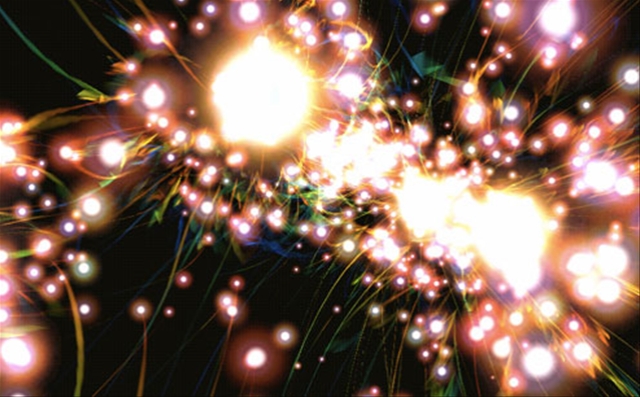
Viewer as the ultimate connection of virtuality and reality: Being the 4th dimension to the liquid architecture in a 3D reality
Vibeke Sorensen’s Sanctuary strives to put the viewer into the center of the piece by surrounding the footage in a temple-like structure with a special set-up that will bring one’s emotions to life through scents and other instruments used. Sitting there viewer can feel the power of the video installation as it flows and surrounds him/her. Following are some images from Sanctuary taken from Sorensen’s own web-site.


In my opinion, all animation is a product of liquid architecture of some sort. It is up to artist to give opportunity of becoming part of the work to the viewers. As technology evolves, I'm sure artists will be able to make more delicate and yet more sophisticated animations that will continue mystifying those of us viewing them. I find adaptation of liquid architecture to 3D Reality exciting for the most part, for it utilizes science ( by utilizing technology) while defying its rules and limits.


No comments:
Post a Comment